Many Saudi, Kuwaiti, Qatari, Bahraini and Omani buyers would like to use finance for a Dubai home but only in a way that fits their faith. Dubai has a large Islamic banking sector, and several UAE banks publish home finance products for people who live outside the UAE. These products replace an interest-bearing loan with Sharia-compliant structures such as Ijara (lease ending in ownership) and Murabaha (cost-plus sale).
This guide explains how Islamic home finance works in Dubai, what the UAE Central Bank allows, what three of the country's Islamic banks publish for non-resident buyers, and what it costs on a real-world example in AED, SAR and other GCC currencies. It uses official sources: the UAE Central Bank (CBUAE) rulebook, the Dubai Land Department (DLD), Dubai's legislation portal and the banks' own product pages and Key Facts Statements. It is general information only, not financial or religious advice. Speak to the bank, a licensed mortgage adviser and, if you wish, your own scholar before you commit.
New to buying in Dubai as a GCC national? Start with our guide to ownership rights, fees and steps for Saudi and GCC nationals. Looking for a family home? See our guide to Dubai family villas and holiday homes for GCC buyers.
Exchange rates used in this guide (22 November 2026): USD 1 = AED 3.6725 (UAE peg). Saudi riyal, Qatari riyal, Bahraini dinar and Omani rial figures are worked out from each currency's fixed US dollar peg (SAR 3.75, QAR 3.64, BHD 0.376 and OMR 0.3845 per USD), which gives AED 1 = SAR 1.0211, QAR 0.9912, BHD 0.1024 and OMR 0.1047. The Kuwaiti dinar is pegged to a basket, so KWD figures use about AED 1 = KWD 0.0846 (ExchangeRate-API, 22 November 2026: 0.0847; FloatRates, 20 November 2026: 0.0845) and are rounded. All converted figures are approximate and for illustration only.
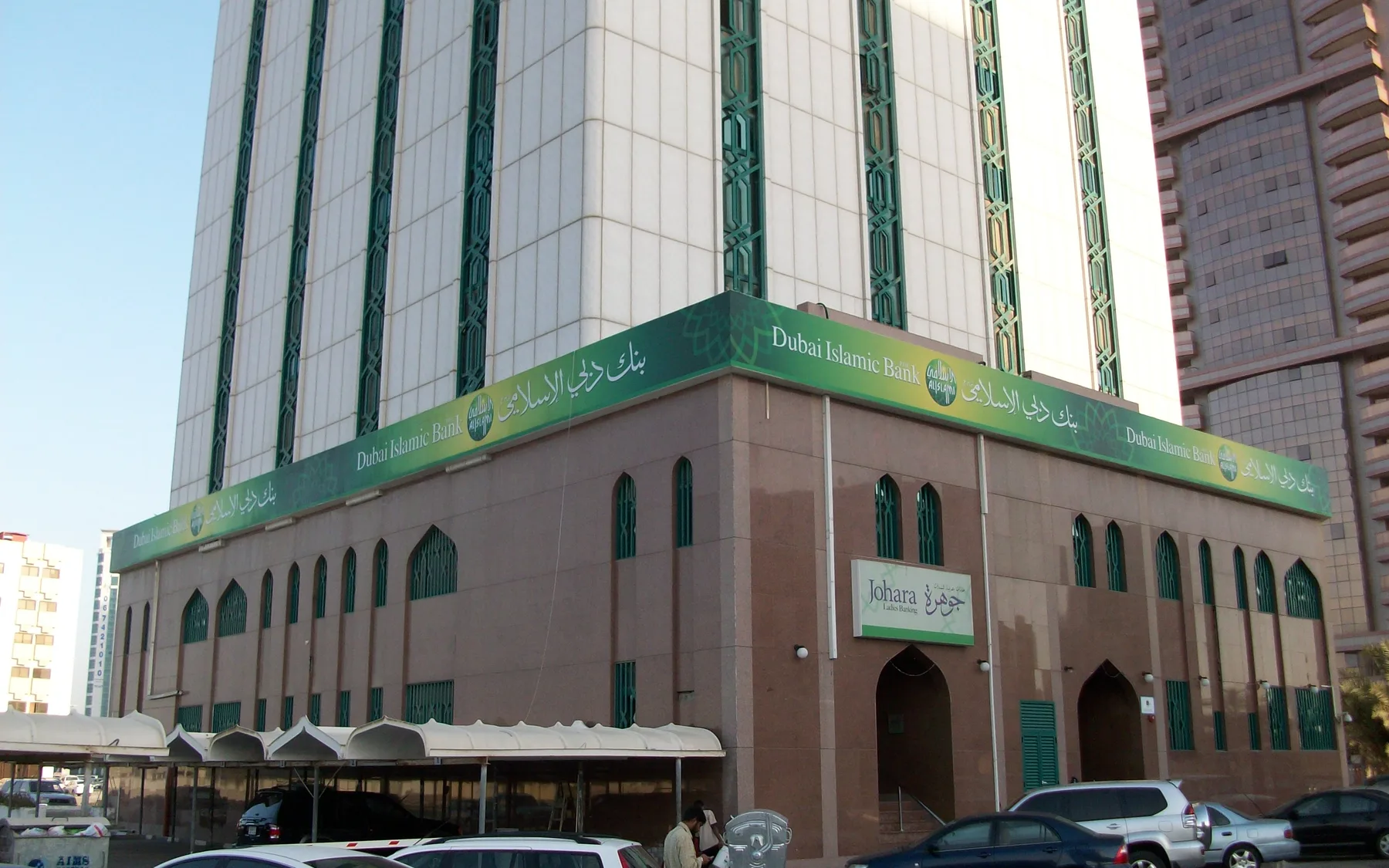
A Dubai Islamic Bank building. Credit: Mahmoud Farrag, via Wikimedia Commons, CC BY 3.0
The Short Answer
| Can a Saudi or GCC national get Islamic home finance in Dubai? | Yes, subject to each bank's credit checks. Dubai Islamic Bank, Emirates Islamic and Abu Dhabi Islamic Bank all publish home finance options for non-residents |
|---|---|
| How does it work? | Usually Ijara: the bank buys the home and leases it to you, and ownership passes to you once all payments are made. Homes under construction use Istisna'a with a forward Ijara |
| How much can I borrow? | CBUAE caps loan-to-value at 50% for any off-plan home. For ready homes the caps are higher, but banks can set lower limits; ADIB's non-resident page says up to 50% of the property value |
| Longest term | 25 years under CBUAE rules; each bank sets the maximum age at the final payment (ADIB: 65 for non-residents) |
| Main Dubai costs | DLD registration fee of 4% of the price, plus 0.25% of the finance amount to register the bank's mortgage with DLD, plus the bank's own fees and Takaful (Islamic insurance) |
| Is it regulated? | Yes. Islamic banks follow the same CBUAE mortgage rules as conventional banks, and their products are overseen by internal Sharia committees supervised by the CBUAE's Higher Shari'ah Authority |
How Islamic Home Finance Works
Conventional mortgages charge interest on a loan, which is not permitted under Sharia. Islamic banks instead buy, lease or sell the property itself and earn a profit or rent. The structures UAE banks publish for home finance are:
| Structure | How it works | Typically used for |
|---|---|---|
| Ijara (Ijarah Muntahia Bittamleek) | The bank buys the home from the seller and leases it to you for an agreed term. Your monthly rental covers the bank's cost and profit. When all payments are complete, the bank transfers ownership to you | Ready homes, resales, buyouts from another bank |
| Istisna'a with forward Ijara | The bank commissions the described home under an Istisna'a contract while it is being built, then leases it to you once complete. Some banks collect advance rental during construction | Off-plan and under-construction homes |
| Murabaha | The bank buys the asset and sells it to you at cost plus a disclosed profit, paid in instalments | Offered by some banks for property; Dubai Islamic Bank publishes a Sharia certificate for a property finance Murabaha |
Two practical points from Dubai Islamic Bank's Key Facts Statement show how Ijara works in Dubai. The bank owns the property for the term of the finance, but the home can stay registered in your name as the bank's "title agent", with a mortgage registered at DLD in the bank's favour as security. And Life Takaful and Property Takaful (Sharia-compliant insurance) are mandatory.
On the regulatory side, the CBUAE's Higher Shari'ah Authority sets Sharia rules and standards for licensed Islamic financial institutions and supervises each bank's internal Sharia supervision committee. The CBUAE also requires Islamic banks in the UAE to apply AAOIFI Sharia standards. Each bank publishes Sharia certificates for its products, so ask to see the certificate for the product you are offered.
What the UAE Central Bank Allows
The CBUAE's Regulations Regarding Mortgage Loans apply to banks lending to UAE nationals, GCC nationals and expatriates, and Article 6 confirms that Sharia-compliant home finance must follow the same rules. These are the maximums. Banks can and do set stricter limits.
| Rule | UAE nationals | Expatriates |
|---|---|---|
| First home (owner-occupier), value up to AED 5 million (SAR 5.11 million) | 85% loan-to-value | 80% loan-to-value |
| First home (owner-occupier), value above AED 5 million | 75% | 70% |
| Second home or investment property | 65% | 60% |
| Any off-plan purchase | 50%, regardless of purpose, value or buyer category | |
| Maximum term | 25 years | |
| Maximum finance amount | 8 years' annual income | 7 years' annual income |
| Debt burden | Total repayments up to 50% of gross income, stress-tested at 2 to 4 percentage points above the current rate | |
Source: CBUAE Rulebook, Regulations Regarding Mortgage Loans, Article 3 (consolidated 8 April 2020).
What this means for GCC buyers: the regulation sets its loan-to-value bands for "UAE nationals" and "expatriates" and doesn't say which band applies to other GCC nationals, so ask each bank how it treats your nationality. The down payment must come from your own resources, not from another loan or credit card, and banks must pay your own share to a developer before releasing any finance on a home under construction. Repayments must come from salary or verifiable business or rental income.
What Three Islamic Banks Publish for Non-Residents
We checked each bank's own product pages and Key Facts Statements on 22 November 2026. Profit rates change often and depend on your profile, so we haven't quoted them. Ask for a current Key Facts Statement before you apply.
| Bank | What it publishes for non-residents | Structure |
|---|---|---|
| Dubai Islamic Bank (DIB) | A dedicated Non-Resident Program for resale homes, ready homes bought from developers and buyouts of existing finance, with no salary transfer and a "Low-Doc" non-resident policy (details from a home finance adviser). Early settlement fee of 1% of the outstanding principal or AED 10,000, whichever is less, plus VAT | Ijara for ready homes; forward Ijara for homes under construction |
| Emirates Islamic | States that non-residents can apply and lists documents for salaried and self-employed non-residents (passport, salary certificate or business documents, six months of bank statements, liability letter, tax returns and credit report where applicable). Finance up to AED 25 million; its 80% figure is for expatriates, and it publishes no separate limit for non-residents | Ijarah; Istisnaa with Ijarah for homes under construction |
| Abu Dhabi Islamic Bank (ADIB) | Finance up to 50% of the property value. Salaried: monthly salary of AED 15,000 (SAR 15,317), aged 25 at application and no older than 65 at maturity, property in any emirate. Self-employed: annual turnover of AED 3 million (SAR 3.06 million), aged 30 at application and no older than 65 at maturity, property in Abu Dhabi or Dubai only. No early settlement fee when you sell the property. Its Key Facts Statement says non-residents pay a higher profit rate and higher advance rental than residents | Purchase and lease back (Ijarah) for ready homes; Istisna'a and forward Ijarah for homes under construction |
Sources: DIB Non-Resident Program page and Home Finance Key Facts Statement (May 2026); Emirates Islamic Home Finance and Apply for Home Finance pages; ADIB Non-Resident Home Finance page and Home Finance Key Facts Statement. Checked 22 November 2026.
Other UAE banks also offer home finance for off-plan homes; for one example, see our article on Mashreq's off-plan home financing at Expo City Dubai.
Worked Example: A AED 3 Million Ready Apartment
This is an illustration, not an offer: a ready two-bedroom apartment at AED 3,000,000, close to the median two-bedroom price in Business Bay in the market data below, financed at 50% of the value, the maximum ADIB publishes for non-residents.
| Item | AED | SAR | QAR | KWD | BHD | OMR |
|---|---|---|---|---|---|---|
| Purchase price | 3.00 million | 3.06 million | 2.97 million | 253,800 | 307,100 | 314,100 |
| Your 50% down payment | 1.50 million | 1.53 million | 1.49 million | 126,900 | 153,600 | 157,000 |
| Bank finance (50%) | 1.50 million | 1.53 million | 1.49 million | 126,900 | 153,600 | 157,000 |
| DLD registration fee (4% of price) | 120,000 | 122,500 | 118,900 | 10,152 | 12,286 | 12,564 |
| DLD mortgage registration (0.25% of finance) | 3,750 | 3,829 | 3,717 | 317 | 384 | 393 |
Converted at the rates above; rounded. KWD at about AED 1 = KWD 0.0846.
So before the bank's own fees, you would need about AED 1.62 million (SAR 1.66 million) in cash: the down payment, the 4% DLD fee and the mortgage registration fee. Also budget for:
- The bank's fees: processing or arrangement fees, valuation and advance rental, as listed in the bank's Key Facts Statement.
- Takaful: life and property cover, usually required for the term of the finance.
- DLD trustee and title deed fees and, on a resale, agency commission. Our guide to Dubai property taxes and fees covers these.
On an off-plan home, the 50% cap applies to every buyer, and the bank only starts paying once your own share has been paid to the developer. ADIB's Key Facts Statement also lists finance for the final handover payment due to the developer, which can suit a plan where a large share is due at completion. Our explainer on the Palm Springs 60/40 payment plan shows how a handover-heavy plan works.
Downtown Dubai from the air. Credit: Tim Reckmann, via Wikimedia Commons, CC BY-SA 3.0
Market Data: Two-Bedroom Apartments in Areas GCC Buyers Ask About
These are Dubai Land Department figures for two-bedroom apartments in six areas. Prices and rents are medians; the change is DXBinteract's year-on-year move in price per square foot.
| Area (2-bed apartments) | Median price | Price per sq ft and yearly change | Sales (12 months) | Median annual rent |
|---|---|---|---|---|
| Jumeirah Village Circle (JVC) | AED 1.65 million (SAR 1.69 million) | AED 1,310 (SAR 1,338), up 1.8% | 1,413 | AED 93,000 (SAR 94,963) |
| Dubai Marina | AED 2.55 million (SAR 2.60 million) | AED 1,860 (SAR 1,899), down 7.3% | 616 | AED 135,000 (SAR 137,800) |
| Dubai Hills Estate | AED 2.57 million (SAR 2.62 million) | AED 2,320 (SAR 2,369), down 6.9% | 604 | AED 140,000 (SAR 143,000) |
| Business Bay | AED 2.98 million (SAR 3.04 million) | AED 2,410 (SAR 2,461), up 2.8% | 1,404 | AED 125,000 (SAR 127,600) |
| Downtown Dubai | AED 3.80 million (SAR 3.88 million) | AED 2,780 (SAR 2,839), down 1.7% | 913 | AED 175,000 (SAR 178,700) |
| Palm Jumeirah | AED 5.90 million (SAR 6.02 million) | AED 3,400 (SAR 3,472), up 21.4% | 413 | AED 200,000 (SAR 204,200) |
Source: DXBinteract (Dubai Land Department transaction data), as of November 2026. DXBinteract notes that reporting windows can differ by metric. SAR at AED 1 = SAR 1.0211; rounded. Gross yield figures are left out because the reported yields didn't match the median prices and rents shown.
JVC has the lowest median price in the group, while Business Bay and JVC each recorded more than 1,400 two-bedroom sales. Palm Jumeirah has the highest price per square foot. For how rents compare by unit size, see our Dubai rental yield by bedroom type study and our Business Bay area guide.
Checklist Before You Apply
- Decide ready or off-plan. The 50% off-plan cap applies to everyone, while ready homes have higher loan-to-value caps.
- Get a pre-approval before you sign a sale agreement, so you know your limit and the bank's profit rate.
- Prepare documents from home: passport, salary certificate or company documents, six months of bank statements, a liability letter and, where they apply, tax returns and a credit report.
- Ask for the Key Facts Statement and the Sharia certificate for the exact product, and compare the profit rate, advance rental, fees and early settlement terms.
- Check the property is acceptable to the bank. Banks use independent valuers, and the finance is based on the bank's valuation, not the agreed price.
- Plan your currency transfers. AED, SAR, QAR, BHD and OMR are all pegged to the US dollar, so currency swings between them are small; the Kuwaiti dinar moves a little more.
- Ask a UAE lawyer to review the sale agreement and the finance documents before you sign.
How Luxwell Helps
Luxwell Real Estate is a team of commercial real estate experts based in Churchill Executive Tower, Business Bay, and we also help GCC buyers purchase homes across Dubai. Our COO Divya Wadhwa and CSO Nikhil Wadhwa can shortlist ready and off-plan homes that fit your finance limit, compare recent DLD prices, and coordinate with your bank, valuer and lawyer around your trip. If you are also looking at offices or shops, see our guide to commercial real estate in Dubai. We don't give financial, legal or religious advice, but we work alongside your advisers.
- Call or WhatsApp: +971 50 856 2749
- Email: info@luxwellrealestate.com
- Contact form: Contact Luxwell
This article is general information only and is not financial, legal or religious advice. Bank products, fees and rules change, so confirm them with the bank, DLD and a UAE lawyer before you decide. Information checked 22 November 2026.
ملخص باللغة العربية
التمويل العقاري الإسلامي في دبي لمواطني السعودية ودول الخليج
- الصيغ المتاحة: تعتمد البنوك الإسلامية في الإمارات غالباً على صيغة الإجارة المنتهية بالتمليك للعقارات الجاهزة، إذ يشتري البنك العقار ويؤجره للمتعامل ثم تنتقل الملكية إليه بعد سداد جميع الدفعات، وعلى الاستصناع مع الإجارة الموصوفة في الذمة للعقارات قيد الإنشاء. ويقدم بعض البنوك صيغة المرابحة.
- قواعد المصرف المركزي: الحد الأقصى لنسبة التمويل إلى القيمة للعقارات على الخارطة 50% لجميع المشترين، وأقصى مدة للتمويل 25 سنة، ولا يتجاوز إجمالي الأقساط 50% من الدخل. وتخضع البنوك الإسلامية للقواعد نفسها، وتشرف الهيئة العليا الشرعية لدى المصرف المركزي على هيئات الرقابة الشرعية الداخلية في البنوك.
- لغير المقيمين: يقدم بنك دبي الإسلامي برنامجاً خاصاً لغير المقيمين، ويقبل الإمارات الإسلامي طلبات غير المقيمين، ويمول مصرف أبوظبي الإسلامي غير المقيمين حتى 50% من قيمة العقار بحد أدنى للراتب الشهري 15,000 درهم (15,317 ريال سعودي).
- مثال: شقة جاهزة بقيمة 3 ملايين درهم (3.06 مليون ريال سعودي) بتمويل 50%، تتطلب دفعة أولى 1.5 مليون درهم (1.53 مليون ريال سعودي)، ورسوم تسجيل لدى دائرة الأراضي والأملاك 4% أي 120,000 درهم (122,532 ريال سعودي)، ورسوم تسجيل الرهن 0.25% من مبلغ التمويل أي 3,750 درهماً (3,829 ريال سعودي)، إضافة إلى رسوم البنك والتأمين التكافلي.
- أسعار الصرف: 1 درهم = 1.0211 ريال سعودي تقريباً (22 نوفمبر 2026)، والأرقام المحولة للتوضيح فقط.
هذا المقال معلومات عامة وليس استشارة مالية أو قانونية أو شرعية. للاستفسار عن شراء عقار في دبي، تواصلوا مع Luxwell Real Estate عبر واتساب على الرقم 2749 856 50 971+.
Sources
- UAE Central Bank: Regulations Regarding Mortgage Loans and Article 3: Important Ratios; Higher Shari'ah Authority
- Dubai Land Department: Mortgage registration application (0.25% of the mortgage value) and Property sale registration
- Dubai Legislation Portal: Executive Council Resolution No. 30 of 2013 Approving Fees of the Land Department
- Dubai Islamic Bank: Non-Resident Program and Home Finance Key Facts Statement
- Emirates Islamic: Home Finance and Apply for Home Finance
- Abu Dhabi Islamic Bank: Non-Resident Home Finance and Home Finance Key Facts Statement
- Market data: DXBinteract (Dubai Land Department transaction data), November 2026
- Exchange rates: US dollar pegs of the UAE, Saudi, Qatari, Bahraini and Omani central banks; ExchangeRate-API and FloatRates for KWD, 20 to 22 November 2026
Related Reading
Frequently Asked Questions
Can Saudi and other GCC nationals get Islamic home finance in Dubai without living in the UAE?
- Yes, subject to each bank's credit assessment. Dubai Islamic Bank runs a Non-Resident Program, Emirates Islamic states that non-residents can apply and lists the documents they need, and Abu Dhabi Islamic Bank publishes non-resident home finance of up to 50% of the property value.
How does Ijara home finance work in Dubai?
- Under Ijara, the bank buys the home and leases it to you for an agreed term. Your monthly rental covers the bank's cost and profit, and ownership passes to you once all payments are made. The home can stay registered in your name as the bank's title agent, with a mortgage registered at the Dubai Land Department in the bank's favour.
How much can I finance on a Dubai off-plan property?
- The UAE Central Bank caps finance at 50% of the value for any property bought off-plan, regardless of the buyer's nationality, purpose or the property value. The bank must also wait until your own share has been paid to the developer before it releases any finance.
What is the maximum term for Islamic home finance in the UAE?
- The UAE Central Bank sets a maximum term of 25 years. Each bank sets the maximum age at the final payment; Abu Dhabi Islamic Bank, for example, publishes a maximum of 65 at maturity for non-residents.
What fees do I pay when I buy a Dubai home with Islamic finance?
- The main government fees are the DLD registration fee of 4% of the price and 0.25% of the finance amount to register the bank's mortgage. On a AED 3,000,000 home financed at 50%, that is AED 120,000 (SAR 122,500) plus AED 3,750 (SAR 3,829). Budget too for the bank's fees, advance rental and Takaful as shown in its Key Facts Statement.
Are Islamic banks in the UAE regulated differently from conventional banks?
- They follow the same UAE Central Bank mortgage rules, including loan-to-value caps and the 50% debt burden limit. In addition, each Islamic bank has an internal Sharia supervision committee, overseen by the Central Bank's Higher Shari'ah Authority, and must apply AAOIFI Sharia standards.
Request details
Leave your details to download the details